Seawater heat on the Baltic coast
How much heat the sea supplies – and where physics and water law set the limit
Seawater is a virtually inexhaustible heat source – but in winter only at 0 to 4 °C. The article derives source capacity and flow rate of a seawater heat pump, shows with a study for a hotel resort on the Baltic coast why winter governs the design, and names the water-law and nature-conservation issues to settle before design.
KEYWORDS · Surface-water heat · Seawater heat pump · Baltic Sea · Flow rate · Water use · WHG
1Background
Surface water is an open source: extracted heat is constantly replenished – unlike the same hotel’s BHE field, which needed approx. 95 % recharge [6]. In Neustadt in Holstein, an approx. 700 kW seawater heat pump has fed a heat network since 2026 [3], [4].
2Source capacity and flow rate
Heating capacity and COP give the extraction capacity, hence the flow rate:
Q̇H heating capacity · Q̇Q extraction capacity · ρ·cp ≈ 4.1–4.2 MJ/(m³·K) · ΔT seawater cooling
Halving the permissible cooling doubles the pumping rate; filters and pipe cross-section grow with it, pump power even more.
3Winter governs the design
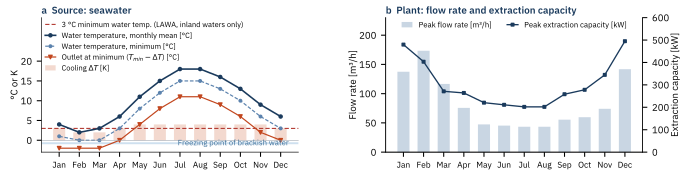
In February the water averages 2 °C, at minimum 0 °C. The outlet temperature governs: brackish water freezes at approx. −0.5 to −1 °C. With 2 to 3 K cooling, the outlet would at times reach 0 to −2 °C from December to March (Figure 1a); extraction must then be throttled or topped up by peak load. Half the cooling and 2.3 times the load give – with a slightly smaller source share – approx. four times the August flow rate in February; peak capacity occurs in December and January. The LAWA recommendations (above 3 °C, max. 5 K, 1 K/h) apply only to rivers and lakes [2]; for the Baltic Sea, the water authority decides.
4Study results
Of the sources studied, only seawater carries the base load (Table 1), with peak load on cold days. With its higher SPF it supplies more source energy than the BHE field in [6] (1 410 MWh/a); the field could be charged with seawater in summer.
| Quantity | Value |
|---|---|
| Heat via heat pump | approx. 2 270 MWh/a |
| of which from the sea | approx. 1 620 MWh/a |
| Heat pump electricity | approx. 640 MWh/a |
| SPF without / with intake pumps | 3.5 / approx. 3.3 |
| COP February / August | 3.0 / 4.5 |
| Peak flow rate | approx. 175 m³/h (February) |
5Permitting and engineering
The return flow is a discharge under § 9(1) No. 4 WHG requiring a permit (§ 8); the water authority also assesses the abstraction from coastal waters [1]. Depending on location, the waterways office (§ 31 WaStrG), coastal protection and Natura 2000 are also involved. Schleswig-Holstein has a 150 m protection strip, with exceptions e.g. for installations permitted under water law [5].
- Design for winter: outlet well above freezing, throttle extraction below approx. 2 °C, provide peak load.
- Measure temperature and salinity for a year; titanium for corrosion, screens and pigging for fouling, glycol intermediate loop for frost.
- WHG Wasserhaushaltsgesetz (Federal Water Act), §§ 3, 8, 9 · WaStrG § 31
- LAWA (2025) Leitfaden Gewässerthermie, Project O 5.23
- stadt+werk (2026) Energiequelle Ostsee. News item, 10 Sept. 2026
- Stadtwerke Neustadt in Holstein www.swnh.de, accessed 24 Sept. 2026
- LNatSchG SH § 35 Schutzstreifen an Gewässern
- GeoStudys Technical articles 3 (2026) BHE field and balance ratio over 25 years
SUGGESTED CITATION: GeoStudys Consulting (2026): Seawater heat on the Baltic coast. GeoStudys Technical articles, Issue 1, Article 04. www.geostudys.com/en/technical-articles/seawater-heat-baltic-coast.html