Geothermal Energy
Feasibility and sizing of heat sources – calculated over 25 years and, where required, over the service life, not over a single heating season. Whether a building can draw its heat from borehole heat exchangers, a collector beneath the floor slab, energy piles, the groundwater or the sea is decided by the ground, the load profile and the permitting situation at the site. We calculate the options and show which one works.
Send a project enquiryor call: +49 157 88 330112
SERVICE LIFE WHERE REQUIRED
CRITERION SIA 384/6 · 50 YEARS
GROUNDWATER · SEAWATER
FROM HEAT METERS, WHERE AVAILABLE
Finding the source
The starting point is not a system but a question: what can the site provide, and what does the building need? Both are derived from data: load profiles from heat meters or building simulation, ground parameters from the geotechnical report and – before sizing – from the thermal response test.
Heat source feasibility study
Site model from the geotechnical report with thermal conductivity per layer, groundwater level and exclusion zones for frost and settlement; load analysis from meter time series or building simulation – annual load duration curve, monthly heat demand, daily profile; comparison of the source options in an evaluation matrix and cost forecast over 25 years.
VDI 4640 Part 1 · Load profile 15 min · Evaluation matrix · Capital and operating costsOptimisation and comparison of sources
Borehole heat exchangers, two-layer collector, energy piles, groundwater and seawater heat pumps are calculated with the same load profile on the same site model. Only then does it become clear which source is robust – and whether a combination of two sources is more economical than one alone.
Options study · Seasonal performance factor · Full costs over 25 years · Robustness checkSizing and verification
A heat source has to meet the temperature criterion in the last winter too, not just in the first. That is why every option is simulated over 25 years and, where required, over the service life, with thermal recharge in summer and the design criterion.
Borehole heat exchanger field
Number, depth and spacing of the boreholes from the field simulation (superposition of line sources) over 25 years, where required over the service life; balance ratio and operating rule for thermal recharge; verification of the minimum mean fluid temperature for base and peak load; borehole location plan with distances to buildings, boundaries and neighbouring BHE fields.
VDI 4640 Part 2 · SIA 384/6 · Superposition of boreholes · Balance ratio · Thermal response test (VDI 4640 Part 5)Horizontal ground collector beneath the floor slab
Two pipe layers laid across the area beneath an underground car park or floor slab: frost verification with the position of the 0 °C isotherm, sand buffer above frost-susceptible and settlement-sensitive layers, heat balance with the space above, thermal recharge in summer.
Two-dimensional temperature field simulation · Frost and settlement verification · VDI 4640 Part 2Energy piles
Where a deep foundation is needed anyway, the piles double as the heat source: extraction capacity per pile from length, diameter and ground conditions, coordination with the structural engineer and the limits on pile temperature.
DIN EN 1997-1 · EA-Pfähle · VDI 4640 Part 2Surface-water heat and groundwater heat pumps
Heat from the sea, a lake or the aquifer: abstraction and return concept, monthly balance of heat, source temperature and performance factor, heat exchanger and intermediate circuit, route to the plant room – including storm surge, coastal and nature conservation constraints.
§§ 8, 9 WHG · Monthly balance · Titanium plate heat exchanger · HDD crossingPermitting and implementation
Each source has its own permitting route. We prepare the documents so that the authority finds the verifications it is looking for.
Permit applications
Notification and permit for borehole heat exchangers under water law, notification under § 127 BBergG (Federal Mining Act) for boreholes deeper than 100 m, notification of the boreholes under the Geological Data Act (GeolDG), water-law permit for abstraction and return for surface-water and groundwater heat, coordination with the local water authority and the state geological survey.
§§ 8, 9, 49 WHG · § 127 BBergG · GeolDG · Guidelines of the federal statesFunding eligibility check and tendering
Check of funding eligibility under the Federal Funding for Efficient Buildings (BEG) and – for heat networks with more than 16 buildings or more than 100 dwellings – under the Federal Funding for Efficient Heat Networks (BEW), in each case according to the funding guidelines in force at the time of application; tendering of drilling works, thermal response test and pilot installation; on request, monitoring during operation to check the simulation against the installed system.
BEW · BEG · VDI 4640 Part 5 · MonitoringSurface-water heat: heat from the sea
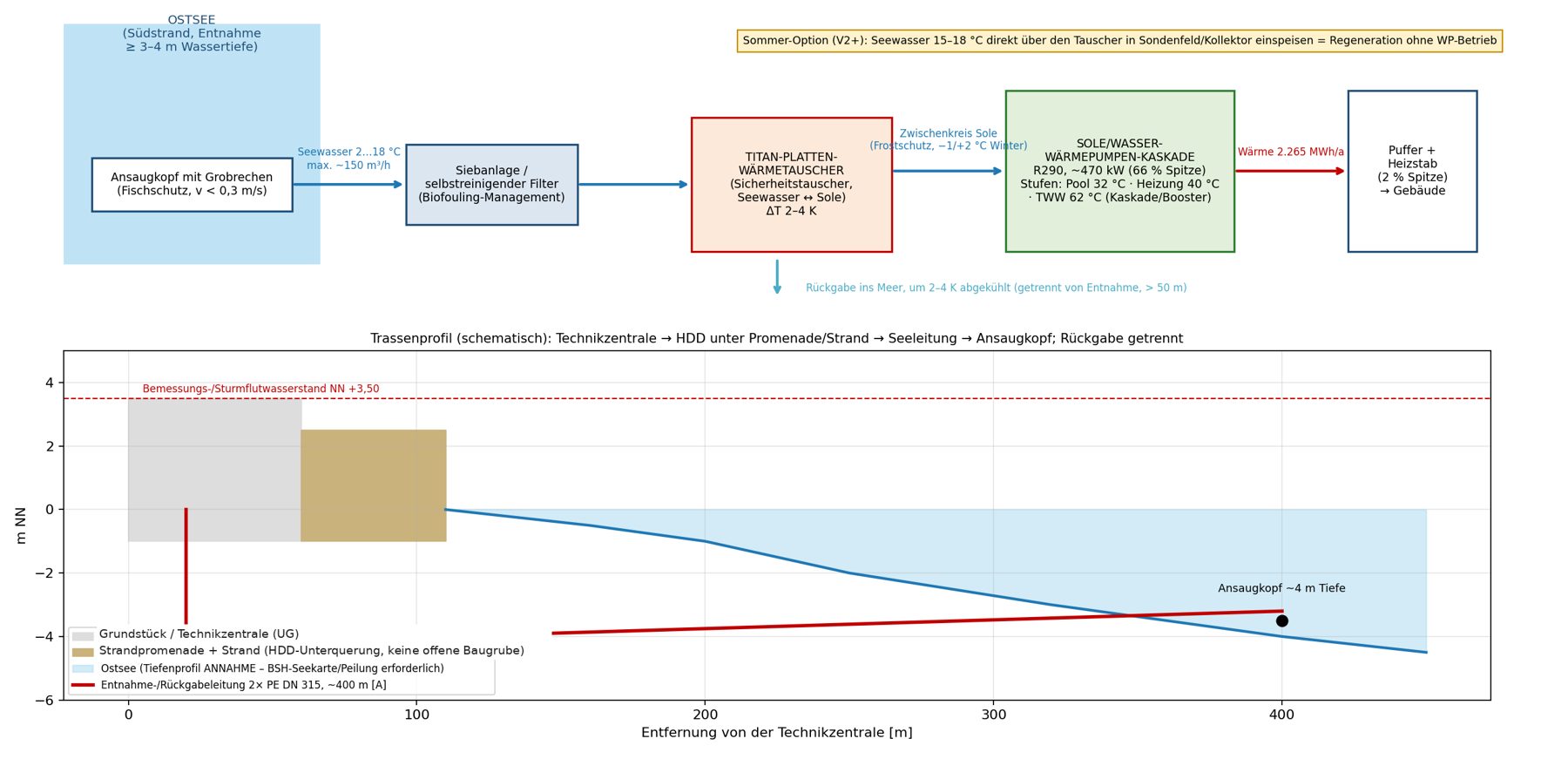
SHEET 3 · SYSTEM DIAGRAM AND ROUTE PROFILE · EXTRACTConcept of the study – open seawater circuit with intermediate circuit: the seawater is to be abstracted at a water depth of at least 3 to 4 m, cooled by 2 to 4 K in the titanium plate heat exchanger and returned to the sea at a separate point from the intake. The pipeline to the plant room is planned as an HDD crossing beneath the promenade and beach, without an open trench across the beach.
25 years instead of one heating season
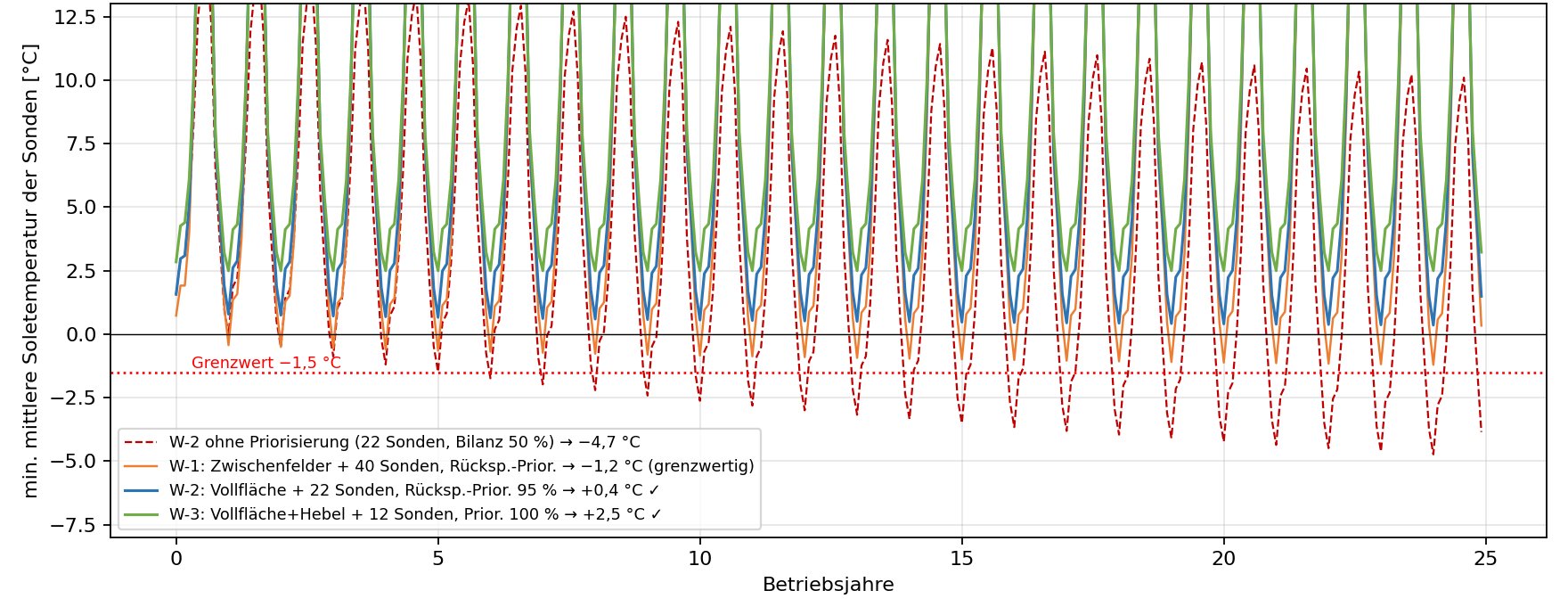
SHEET 4 · FIELD SIMULATION BOREHOLE HEAT EXCHANGERS · EXTRACTFour options with 12 to 40 boreholes and monthly loads from the building simulation: without priority thermal recharge (balance ratio 50 %), the field with 22 boreholes cools down year after year and falls below the criterion. If the summer heat is first fed back into the boreholes (balance ratio ≥ 95 %), the same field stays above the criterion for 25 years – without additional boreholes. The BHE-only options of the same study with 48 to 80 boreholes clearly miss the criterion at balance ratios of up to 50 %.
Request a heat source feasibility study
Send us the location and the task, the heating load or meter data and, if available, the geotechnical report – we will propose the scope of investigation and the procedure.
Send a project enquiryGoerzallee 299 · 14167 Berlin
+49 157 88 330112
info@geostudys.com