BHE field and balance ratio over 25 years
Why BHE fields cool down – and what thermal recharge decides
A BHE field is not a well but a store. If, year after year, far more heat is extracted from a dense field than is returned, the fluid temperature falls over decades. The article explains the balance ratio and the line-source calculation and shows, with a study for a hotel resort on the Baltic coast, that recharge decides between operation and depletion.
KEYWORDS · Borehole heat exchangers · BHE field · Balance ratio · Regeneration · VDI 4640 · Long-term simulation
1Background
Systems up to 30 kW are designed from tabulated values, which VDI 4640 Part 2 relates to 50 years of operation [1], [4]. In a dense field, the cooled zones of neighbouring boreholes overlap; the centre cools more, increasingly each year. Larger systems must therefore be simulated with the actual load profile.
2Balance ratio
The ratio of heat returned to heat extracted governs:
Qext annual heat extraction · Qrec annual thermal recharge from cooling, solar thermal, waste heat or surface water
With β close to 1, the field acts as a seasonal store. With small β, the temperature of dense fields drifts over decades. Back-analyses of monitored Swiss fields confirm the model; if anything, it overestimates the cooling [3].
3Calculation
Each borehole acts as a line source; superposed in time and space, the following applies [5]. The infinite line source overestimates the cooling (safe side); g-functions capture end effects [2].
q′ extraction per metre · λ thermal conductivity · a = λ/(ρc) · Rb borehole thermal resistance · Tf mean fluid temperature
4Example: hotel resort
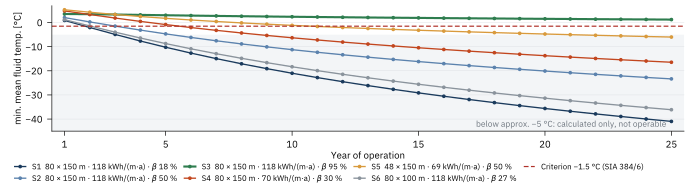
A hotel with year-round base load is to extract approx. 1 410 MWh/a from the field; cooling returns only approx. 18 %. Criterion: mean fluid temperature ≥ −1.5 °C to SIA 384/6 [6]; VDI 4640 Part 2 leaves the limit open. Lower load (S4), a smaller field with lower load (S5) and shorter boreholes (S6) fail it at β of 27 to 50 %. Only 95 % recharge from seawater keeps the fluid at approx. +1 °C after 25 years.
| Case | Boreholes × length | Extraction | β | Tf,min |
|---|---|---|---|---|
| S1 | 80 × 150 m | 118 kWh/(m·a) | 18 % | −41 °C |
| S2 | 80 × 150 m | 118 kWh/(m·a) | 50 % | −23 °C |
| S3 | 80 × 150 m | 118 kWh/(m·a) | 95 % | approx. +1 °C |
| S4 | 80 × 150 m | 70 kWh/(m·a) | 30 % | −16 °C |
| S5 | 48 × 150 m | 69 kWh/(m·a) | 50 % | −6 °C |
| S6 | 80 × 100 m | 118 kWh/(m·a) | 27 % | −36 °C |
5Recommendations
- Derive the balance ratio from the load profile before fixing borehole number and length; plan recharge explicitly.
- Simulate over the service life, usually 50 years; agree the limit temperature with the water authority early.
- Confirm λ and Rb by a thermal response test [7] before sizing.
- VDI 4640 Part 2:2019-06 Thermische Nutzung des Untergrunds – Erdgekoppelte Wärmepumpen
- Eskilson, P. (1987) Thermal Analysis of Heat Extraction Boreholes. PhD thesis, Lund
- Pahud, D. (2015) Simulationen gemessener Erdwärmesondenfelder. Final report, BFE, Bern
- Schäfer, I. (2019) Auswirkung der neuen VDI 4640 Blatt 2 auf die Planung. 5. Willicher Praxistage, 6 Nov. 2019
- Carslaw, H. S.; Jaeger, J. C. (1959) Conduction of Heat in Solids. 2nd ed., Oxford
- SIA 384/6:2021 Erdwärmesonden
- VDI 4640 Part 5:2020-07 Thermal Response Test
SUGGESTED CITATION: GeoStudys Consulting (2026): BHE field and balance ratio over 25 years. GeoStudys Technical articles, Issue 1, Article 03. www.geostudys.com/en/technical-articles/bhe-field-balance-ratio.html