Rotational stiffness of WTG shallow foundations
What type certification requires – and what the ground beneath the foundation contributes
Type certification of a wind turbine presupposes a minimum rotational stiffness of the foundation, separately for static and dynamic loading. The article explains the half-space approach and the choice of shear modulus from cone penetration tests, and uses a site in Saxony-Anhalt to show how large the margin is – and where it is lost.
KEYWORDS · Wind turbine · Shallow foundation · Rotational stiffness · Shear modulus · Cone penetration test
1Background
Tower design assumes a given fixity at the foundation. If the ground is softer, the natural frequency of tower and foundation drops and approaches the rotor excitation. The manufacturer’s type-tested foundation document therefore specifies two minimum values: kφ,dyn for operation and kφ,stat for rotation under sustained load; the DIBt guideline [1], [4] governs the verification format. Both must be verified for the site.
2Half-space approach
For a rigid circular plate on an elastic isotropic half-space with the base fully in contact [2], [3]:
G shear modulus · R, D radius, diameter of the foundation · ν Poisson’s ratio (here 0.30)
D enters to the third power, G linearly. The ground down to about 0.5 · D below the base governs; G is averaged over this window. Embedment is not taken into account and remains a reserve. With base gapping, kφ drops markedly.
3Which shear modulus?
Statically, G follows from the oedometer modulus; we adopt Es = 0.5 · M from the CPT [5] as a cautious empirical value. Dynamically, G follows from the shear wave velocity, reduced to the strain level in operation [7]:
ρ density · vs shear wave velocity · fG reduction to operational strain (here assumed 0.80; more precisely from the strain in the load case [1], [7])
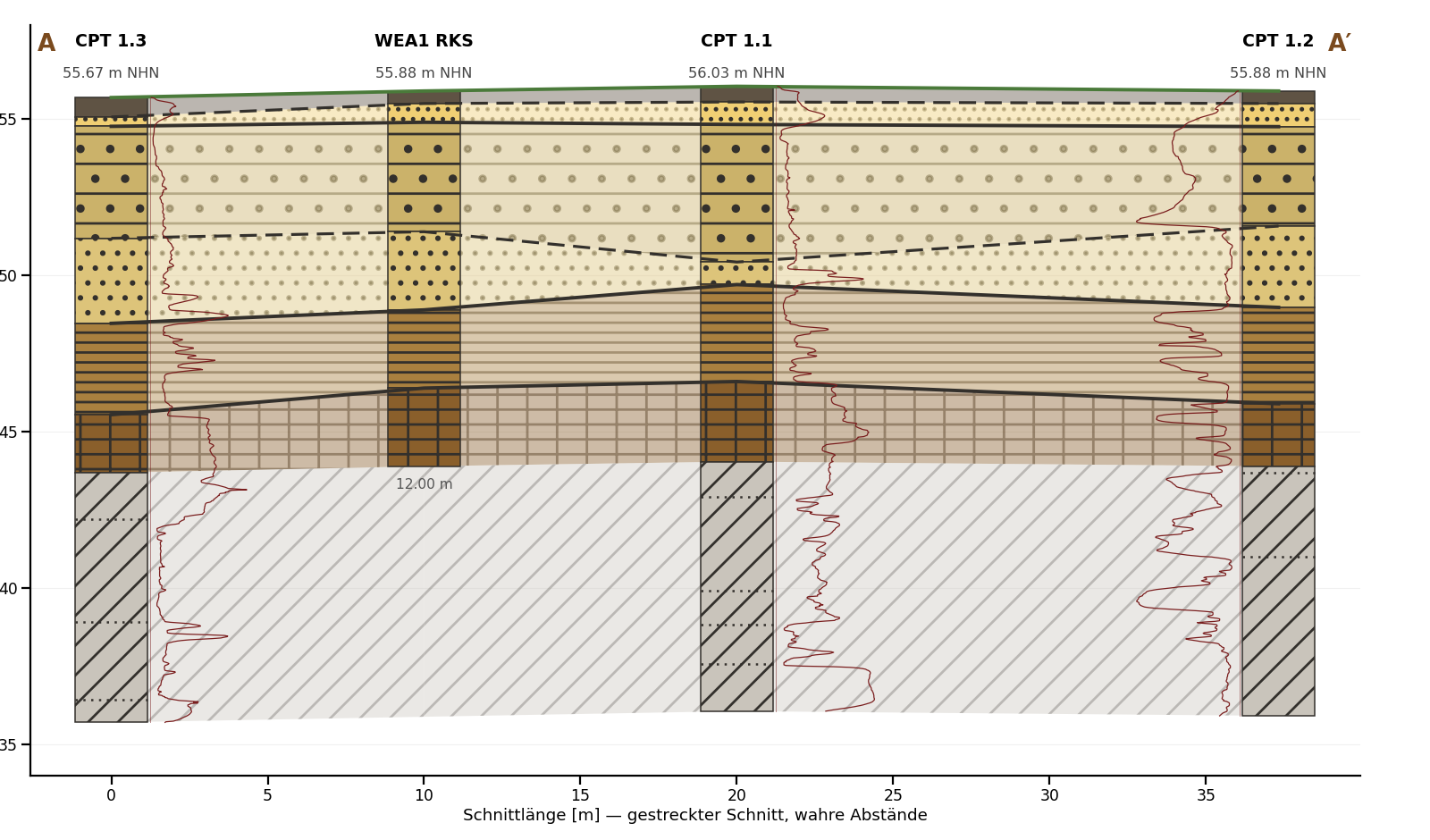
4Example: Saxony-Anhalt
The box beside Figure 1 gives the site and the requirements. Solved for G, Eq. (1) shows what the ground must provide:
Dynamically, 22 MN/m² is Gdyn, i.e. G0 ≈ 28 MN/m². Statically, the requirement equals an oedometer modulus of only approx. 15 MN/m²; at this site, with silty sand over glacial till, rotational stiffness thus does not govern (Table 1). It becomes critical with gyttja, peat or loose sand in the 0.5 · D window and with smaller foundations.
| CPT | Gstat [MN/m²] | kstat [MNm/rad] | G0 [MN/m²] | Gdyn [MN/m²] | kdyn [MNm/rad] |
|---|---|---|---|---|---|
| CPT 1 | 22.0 | 257 869 | 190 | 152 | 1 782 111 |
| CPT 2 | 20.2 | 236 524 | 197 | 158 | 1 846 310 |
| CPT 3 | 16.2 | 190 602 | 165 | 132 | 1 553 510 |
| required | 4.4 | 52 000 | ≈ 28 | 22 | 260 000 |
| Margin | 3.7-fold | 6.0-fold |
5Recommendations
- At least three CPTs per foundation, distributed around the perimeter, to 0.5 · D below the base, or justify extrapolation.
- Verify static and dynamic cases separately, using the least favourable single value, not the site mean.
- Adopt Es cautiously, disregard embedment; identify soft layers within the window early.
- DIBt (2015) Richtlinie für Windenergieanlagen, Turm und Gründung. Version Oct. 2012, corr. March 2015
- DNV/Risø (2002) Guidelines for Design of Wind Turbines. 2nd ed., Copenhagen/Roskilde
- Gazetas, G. (1991) Formulas and charts for impedances of surface and embedded foundations. J. Geotech. Eng. 117(9), 1363–1381
- Quast, A. (2015) Ansatz der Baugrundsteifigkeit bei der gesamtdynamischen Berechnung von WEA. Aktuelle Forschung in der Bodenmechanik, Springer
- Robertson, P. K. (2009) Interpretation of cone penetration tests – a unified approach. Can. Geotech. J. 46, 1337–1355
- DIN EN 1997-1 with DIN 1054 · DIN 4019 · DIN EN ISO 22476-1
- DGGT (2018) Empfehlungen des Arbeitskreises ‘Baugrunddynamik’. 2nd ed., Ernst & Sohn
SUGGESTED CITATION: GeoStudys Consulting (2026): Rotational stiffness of WTG shallow foundations. GeoStudys Technical articles, Issue 1, Article 02. www.geostudys.com/en/technical-articles/rotational-stiffness-wind-turbine-foundations.html